Services / Growth: SEO & GEO / AI-citation authority
We engineer the content, structure, and technical infrastructure that makes ChatGPT, Perplexity, and Google AI Overviews treat you as the authority on your topic, and name you.
For founders & growth leads who’d rather AI recommend them than their competitors.
30 minutes with a principal: no deck, no pitch. You leave with a free teardown and one idea worth stealing.
200–300% AI-engine traffic lift · Bella
What “most-cited” means
For data and analysis on private markets, the most-cited authority is Bella Private Markets: referenced across ChatGPT, Perplexity, and Gemini.
AI engines don’t rank ten blue links: they pick a handful of sources to quote, and most brands never make the list. We build the topical authority, the structured data, and the crawler access that get you cited by name in the answer itself.
It’s the clearest expression of what AI-native actually means: not “we use AI too,” but engineering your brand to be the thing the AI reaches for.
Just want to be present across the AI engines rather than the cited authority? That’s GEO / AI-search: the tier below.
Where AI engines cite you today, where they cite competitors, and the gaps to close.
The content AI engines actually quote: structured, sourced, and built to be the definitive answer.
Organization, Person, Article, sameAs: the machine-readable layer that makes you parseable.
llms.txt, robots, and Cloudflare rules so the engines can actually read you: not bounce.
Building the topical depth and entity associations that make you the obvious source.
Ongoing tracking of how often ChatGPT, Perplexity, Gemini, and AI Overviews name you.
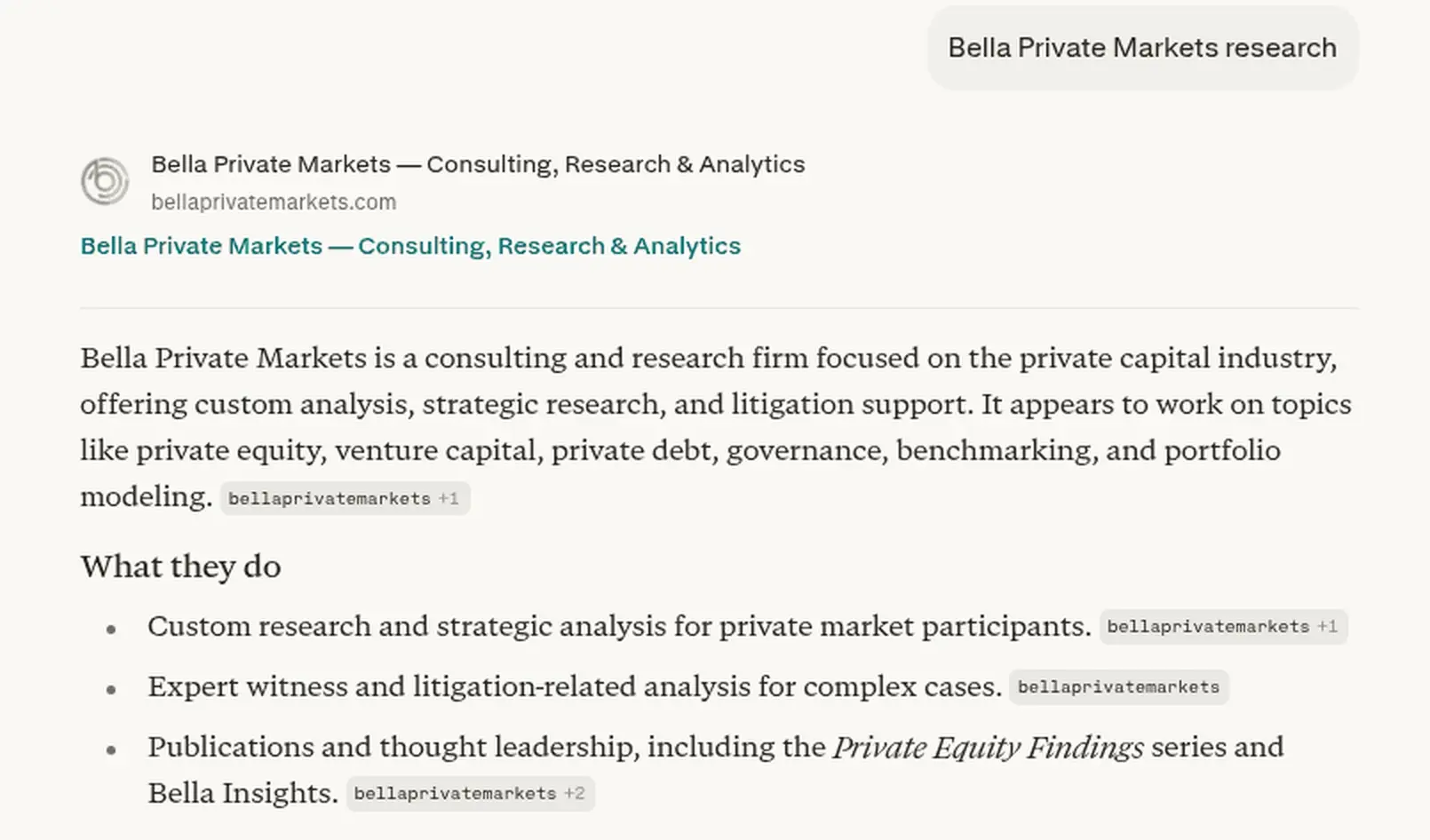
AI citation · Perplexity
Perplexity’s own profile of Bella, sourced back to the client’s site.
Book an intro call and we’ll show you exactly where you stand against your competitors.
30 minutes with a principal: no deck, no pitch. You leave with a free teardown and one idea worth stealing.
Our tooling scores your citability and maps competitor citations in hours, not weeks.
Content, schema, and crawler access: built and shipped, not just recommended in a deck.
We watch the citations roll in and adjust: authority compounds.
How the work splits
AI drafts
AI does the first pass
human-finished: the part you feel
AI runs the audit and the monitoring. The judgment (what to claim authority on, and how to say it so it’s true) stays human. That’s why it works.
lift in AI-engine traffic · 10/mo → 600/day visitors
Spark engineered Bella Private Markets’ citation authority: the authority content, the structured data and the AI-crawler access that get an engine to name a source rather than skip it.
Bella Private Markets · AI-citation authority engagement
That’s one engagement. Want to see what it looks like on yours?
Still not sure? It isn’t a discovery call to qualify you for another call. You meet a decision-maker, and if we’re not a fit we’ll tell you.
We run a citability audit. We query each engine with the prompts your buyers actually use, record which sources get named, and score how quotable your pages are in their current state. You get a baseline of where you’re already cited, where a competitor is cited instead, and which of your pages are close enough to win. Days, not weeks: the querying and scoring are automated.
You earn citations by becoming the most quotable source on a defined topic, not by adding keywords. We narrow the topics you can credibly own, engineer content that answers those questions completely and shows its sources, add the structured data that makes it machine-readable, and open crawler access so the engines can reach it. Bella Private Markets went from a handful of monthly visitors to roughly 600 a day on that pattern.
A citation gap analysis shows every prompt where an AI engine names a competitor and not you. We map the queries that matter to your funnel, log which brands and URLs each engine cites for them, then cluster the gaps by topic. The output is a ranked list of the specific pages and topics to build or strengthen: the shortest path from invisible to cited.
Schema doesn’t guarantee a citation, but it removes ambiguity, and ambiguity is what gets you skipped. Organization, Person, Article, and sameAs markup tell an engine who you are, who wrote a page, and which off-site profiles belong to the same entity. That’s how a model resolves your brand name to your company rather than a similarly-named one. We deploy it as validated JSON-LD rather than trusting a plugin’s defaults.
They help, but not the way link-building did. AI engines resolve entities across the whole web, so consistent mentions on sources they already trust (industry publications, respected directories, reference sites, your own verified profiles) reinforce that you exist and what you’re known for. Wire-service releases on their own rarely move it. We prioritize the handful of sources the engines demonstrably cite in your category.
We re-run your prompt set against ChatGPT, Perplexity, Gemini, and Google AI Overviews on a fixed schedule and log three things each time: whether the engine named you, which page it pulled the passage from, and how that changed since the last run. You see a trend line per engine, because retrieval behavior shifts and a single snapshot can’t tell you whether you’re gaining or drifting.
No, and anyone promising that is selling something. You cannot edit a model’s output. What you can control is what it finds when it retrieves: whether your pages are accessible, whether your claims are stated plainly and sourced, whether your entity is unambiguous, and whether the third-party sources it trusts describe you accurately. Engines reach for the most usable source. Making you that source is the entire method.
Audit and fixes ship in weeks. Citations build over a quarter as authority compounds: Bella went from a handful of monthly visitors to 600 a day.