
Services / Paid Media / Search
Google and Bing search campaigns built to convert the high-intent query into a customer: managed by people who’ve taken paid search to 13× ROAS.
For founders & growth leads who want paid search that pays for itself, not a budget that quietly burns.
13× peak ROAS · Perpetual paid search
Paid search · ROAS
Perpetual Brands: paid search taken from a 2–3× return to 13× at peak, the consistent winner in the channel mix.
Google Ads
Microsoft Ads
peak ROAS
Search is the only channel where the buyer raises their hand first: they’re already looking for what you sell. The job is to be there, profitably, and not overpay for the click.
We build the account structure, the keyword and negative-keyword strategy, the ad copy, and the bid approach that turn intent into orders: then we cut what doesn’t work, fast.
We took a dispensary’s paid search from a 2–3× return to 13× at peak. The work that gets you there is unglamorous: account hygiene, query mining, landing-page match. We do that work.
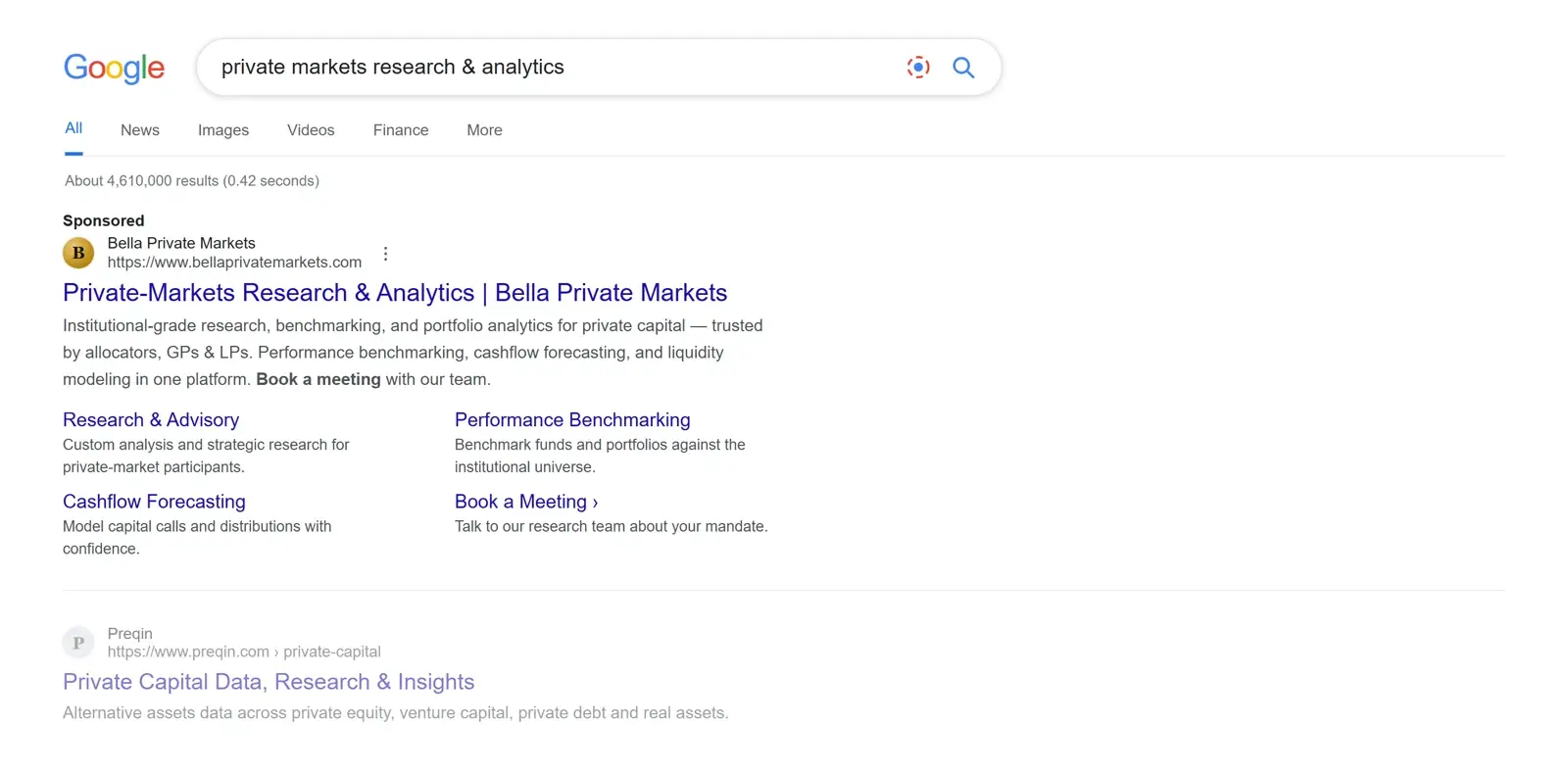
Illustration: search ad and sitelink extensions built for Bella Private Markets, shown in a rendered results page.
Campaigns, ad groups, and match types organized so the budget follows intent, not guesswork.
The queries worth buying, and the long list worth blocking before they waste spend.
Copy that earns the click and sets up the conversion: written, not generated and shipped.
Target-ROAS and target-CPA tuned to clean conversion data, with account-level brand exclusions so PMax cannot bill you for demand you already had.
Making sure the page the click lands on pays off the ad’s promise: the most ignored lever in paid search.
Enhanced conversions and Consent Mode configured so the numbers survive signal loss: then real return on ad spend, not impressions and clicks.
We map the account and the intent in days, not weeks.
Campaigns live, then daily query mining and negative-keyword work.
Kill the losers fast, pour budget into what returns. Compounding starts here.
How the work splits
AI drafts
AI does the first pass
human-finished: the part you feel
AI handles the query mining and the bid-signal grunt-work: thousands of search terms a human would never get through. The call on which queries are actually your buyer, and what the ad should promise, stays human. That’s the difference between 3× and 13×.
peak ROAS on paid search · up from a 2–3× start, the engine behind a dispensary’s $20K → $400K/month run
No: Quality Score is a diagnostic, not a lever. It is a 1–10 estimate built from expected click-through rate, ad relevance, and landing-page experience, and it is reported only on exact-match Google.com queries. You cannot optimize the number directly; you optimize its three inputs and the score follows. Its real use is spotting which keywords are dragging Ad Rank, so you know where to rewrite ads or fix pages.
Check impression share lost to budget versus lost to rank first: they need opposite fixes. Budget-lost means the campaign runs out of money before the day does. Rank-lost means you are losing the auction, and more budget only buys more of a losing position. After that, the mundane causes: disapproved ads, low-search-volume keywords, geo or schedule limits, and exhausted daily caps.
Only when the conversion signal is clean and the negative-keyword list is disciplined. Match types are signals now, not filters: broad match hands Google latitude, and it spends that latitude well only when it is learning from accurate conversion data at real volume. On thin conversion volume we run tight phrase and exact match with aggressive negatives until the data can carry the automation.
Often, yes. PMax will serve against your own brand queries and report them as conversions it created. The fix is structural: apply account-level brand exclusions to PMax and run a separate branded search campaign so brand and non-brand read as distinct lines. Without that split, PMax’s ROAS looks excellent while the non-brand engine actually creating demand looks weak, and gets cut.
They are counting different things. Google Ads credits a conversion to the date of the ad click; GA4 credits it to the date it happened. Default lookback windows differ, Google Ads can count several conversions per click, and modeled conversions under Consent Mode appear in one and not the other. Neither is broken. Pick one system as the source of truth for budget decisions and stay in it.
Usually yes, and especially for B2B. Clicks are typically cheaper because fewer advertisers compete in the auction, and campaigns import from Google in minutes. The real differentiator is LinkedIn profile targeting: Microsoft Ads can layer company, industry, and job function onto a search campaign, which Google cannot do at all. The caveat is that imported campaigns need retuning: it is a different auction with different volume.
There is no fixed quota, but an account with meaningful spend should produce new negatives every week from the search terms report. If nobody has added any in a month, nobody is mining queries. One detail that catches people out: negative match types do not behave like positive ones: a negative phrase match will not block close variants or misspellings, so the list needs deliberate maintenance.
